In the grand equation of life, our emotions don’t always follow straight lines. Instead, they operate on a non-linear scale, responding to success and failure in ways that are often magnified. Success feels larger than life, while failure sometimes seems to pull us down far more than it should. By framing our emotions mathematically, we can begin to understand, and eventually manage, the oscillations of happiness and disappointment.
The Calculus of Success
When we achieve success, our happiness isn’t just an additive gain—it’s a multiplicative boost. This relationship can be expressed as:
\[ H_{\text{success}} = H_{\text{base}} \times (1 + \Delta S) \]
Here:
- \( H_{\text{base}} \): Baseline happiness level.
- \( \Delta S \): Magnitude of success.
The bigger the success, the greater the proportional increase in happiness. This is why achievements often feel like they amplify our sense of well-being far beyond the immediate result.
The Algebra of Failure
Failure, on the other hand, doesn’t feel proportional. A single setback can feel like an exponential drain, pulling our emotional state below zero. This can be modeled as:
\[ H_{\text{failure}} = H_{\text{base}} - (\Delta F)^n, \quad n > 1 \]
Where:
- \( \Delta F \): Magnitude of the failure.
- \( n \): Exponent greater than 1, representing the disproportionate emotional toll.
This explains why one rejection, loss, or mistake can weigh on us far more heavily than it logically should—our brain exaggerates the emotional cost.
The Logic of the Universe
While our emotions may swing dramatically, the universe itself tends to operate on a principle of mean reversion. Just like stock prices that rise and fall back toward an average, life oscillates around a baseline. It’s less like a straight line and more like a sine wave:
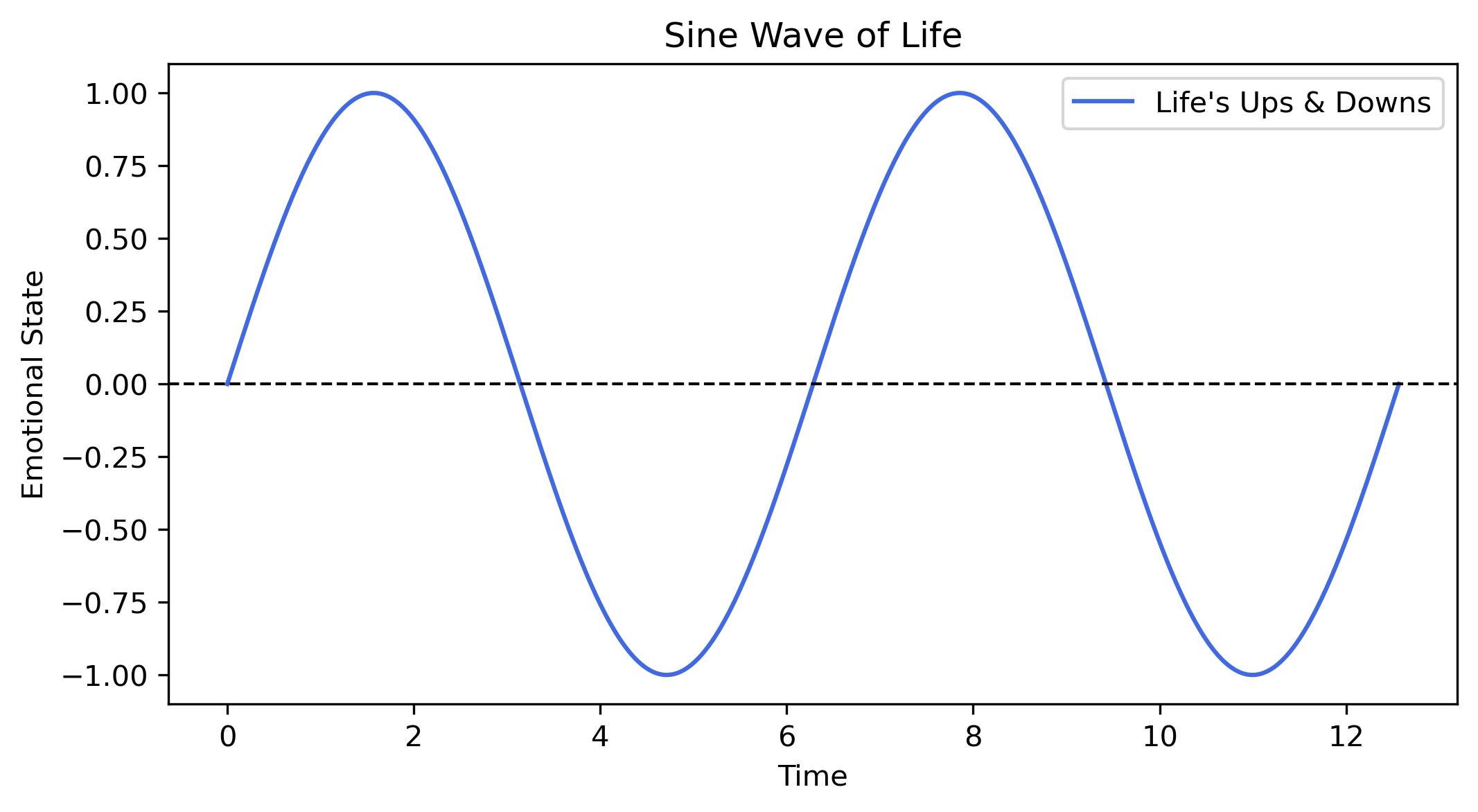
- Acknowledge the Wave: Life is not a monotonically increasing function. It rises and falls in cycles.
- Define a Baseline: Establish a steady emotional midpoint, independent of external outcomes. This is your central axis.
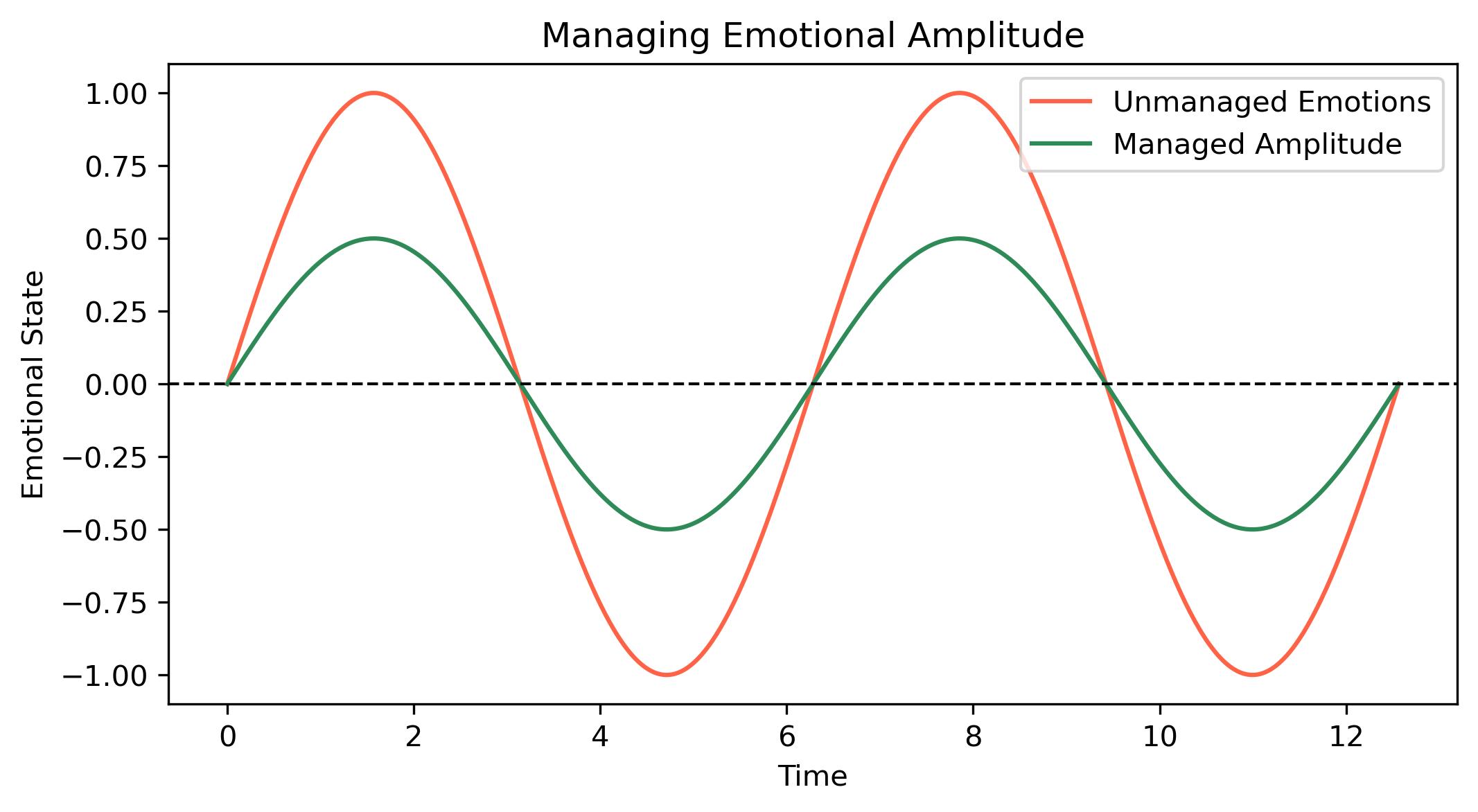
- Manage the Amplitude: Avoid letting success send you to unsustainable highs or failure drag you into deep lows. Control your emotional oscillations.
The Algorithm for Resilience
Life can be seen as a logical system: every input (effort) generates an output (result), but the output is subject to randomness. Resilience doesn’t mean avoiding failure—it means normalizing it.
- Treat Failure as Debugging: Instead of calling it a terminal error, see it as a chance to analyze data, revise code (your strategy), and re-run the program.
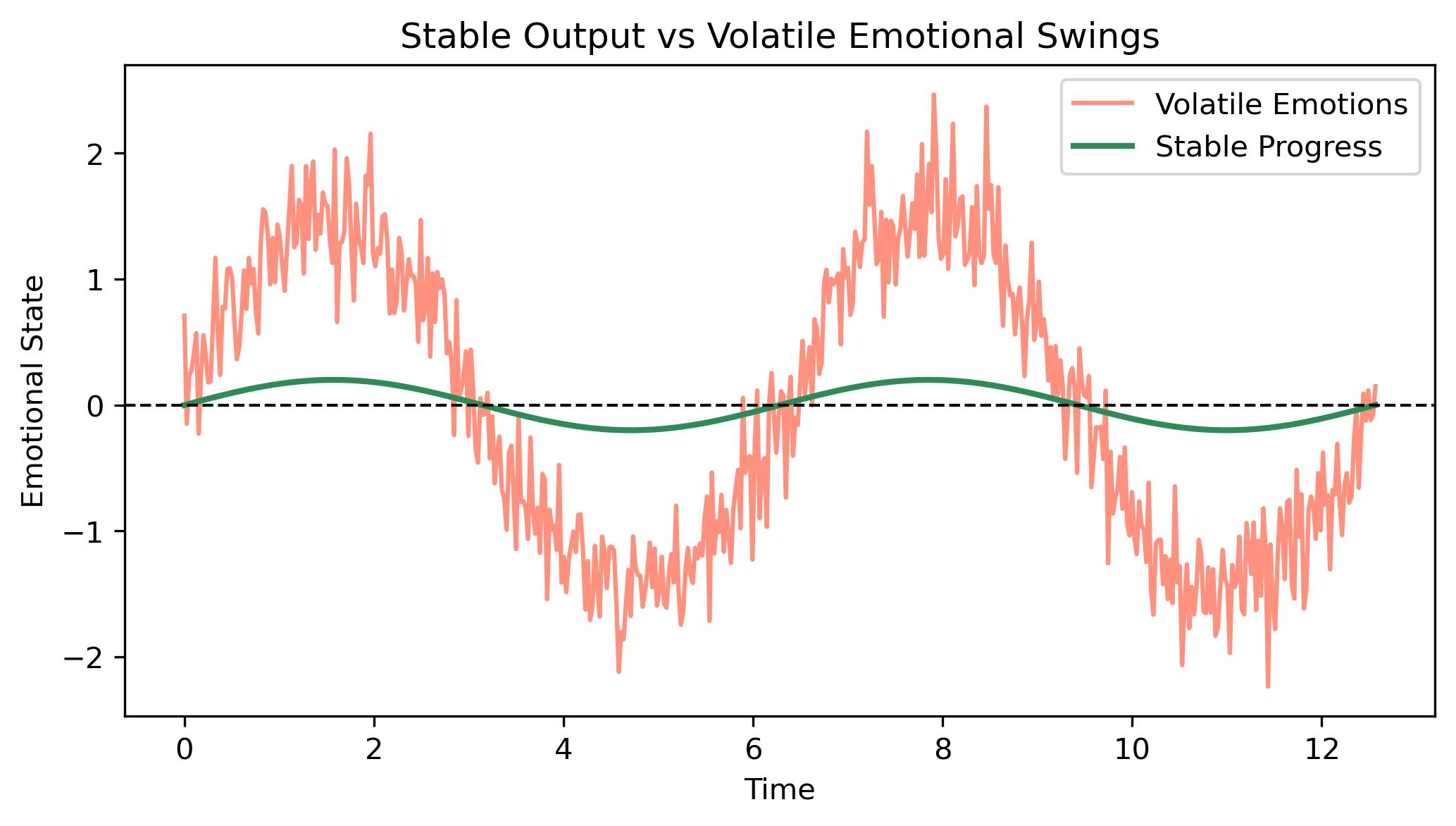
- Optimize for Long-Term Satisfaction: Minimize emotional variance. Don’t chase short-term euphoria at the cost of stability.
- Steady Output Amid Turbulence: While others swing wildly with emotional highs and lows, aim to maintain consistent progress over time.
Conclusion: Rationality in a Probabilistic World
The goal isn’t to become a robot, immune to feeling. It’s to be a rational agent in a world full of uncertainty, understanding that both success and failure are temporary oscillations around a baseline. By acknowledging the sine wave of existence, defining our baseline, and managing the amplitude of emotional reactions, we can navigate success and failure with balance. In the end, contentment is less about avoiding failure or chasing constant success—it’s about mastering the calculus of our emotions.