The groups \(S_3\) and \(D_3\) arise in apparently different ways:
- \(S_3\) is the group of all permutations of three objects.
- \(D_3\) is the group of all symmetries of an equilateral triangle.
However, these two groups have exactly the same algebraic structure. By labeling the vertices of an equilateral triangle, we can understand why
\[ \boxed{D_3\cong S_3}. \]
Labeling the Vertices of the Triangle
Consider an equilateral triangle whose vertices are labeled \(1\), \(2\), and \(3\):
\[ \begin{array}{c} 1\\[2mm] \triangle\\[-1mm] 2\qquad\quad 3 \end{array} \]
Every symmetry of the triangle moves these three vertices to new positions. Therefore, every symmetry produces a permutation of the set
\[ \{1,2,3\}. \]
A symmetry is a movement of the triangle that leaves it occupying exactly the same region as before. The triangle may be rotated or reflected, but its final position must coincide with its original position.
What Is the Symmetric Group \(S_3\)?
The symmetric group \(S_3\) is the group of all permutations of the set \(\{1,2,3\}\).
Since three objects can be arranged in \(3!\) ways,
\[ |S_3|=3!=6. \]
The six elements of \(S_3\) are
\[ S_3=\{e,(123),(132),(12),(13),(23)\}. \]
- \(e\) is the identity permutation.
- \((123)\) and \((132)\) are \(3\)-cycles.
- \((12)\), \((13)\), and \((23)\) are transpositions.
We will now see that these six permutations correspond exactly to the six symmetries of an equilateral triangle.
What Is the Dihedral Group \(D_3\)?
The dihedral group \(D_3\) is the group of all symmetries of an equilateral triangle.
An equilateral triangle has:
- three rotational symmetries;
- three reflectional symmetries.
Therefore,
\[ |D_3|=3+3=6. \]
We denote the rotations by
\[ e,\quad r,\quad r^2, \]
and the reflections by
\[ s_1,\quad s_2,\quad s_3. \]
Thus,
\[ D_3=\{e,r,r^2,s_1,s_2,s_3\}. \]
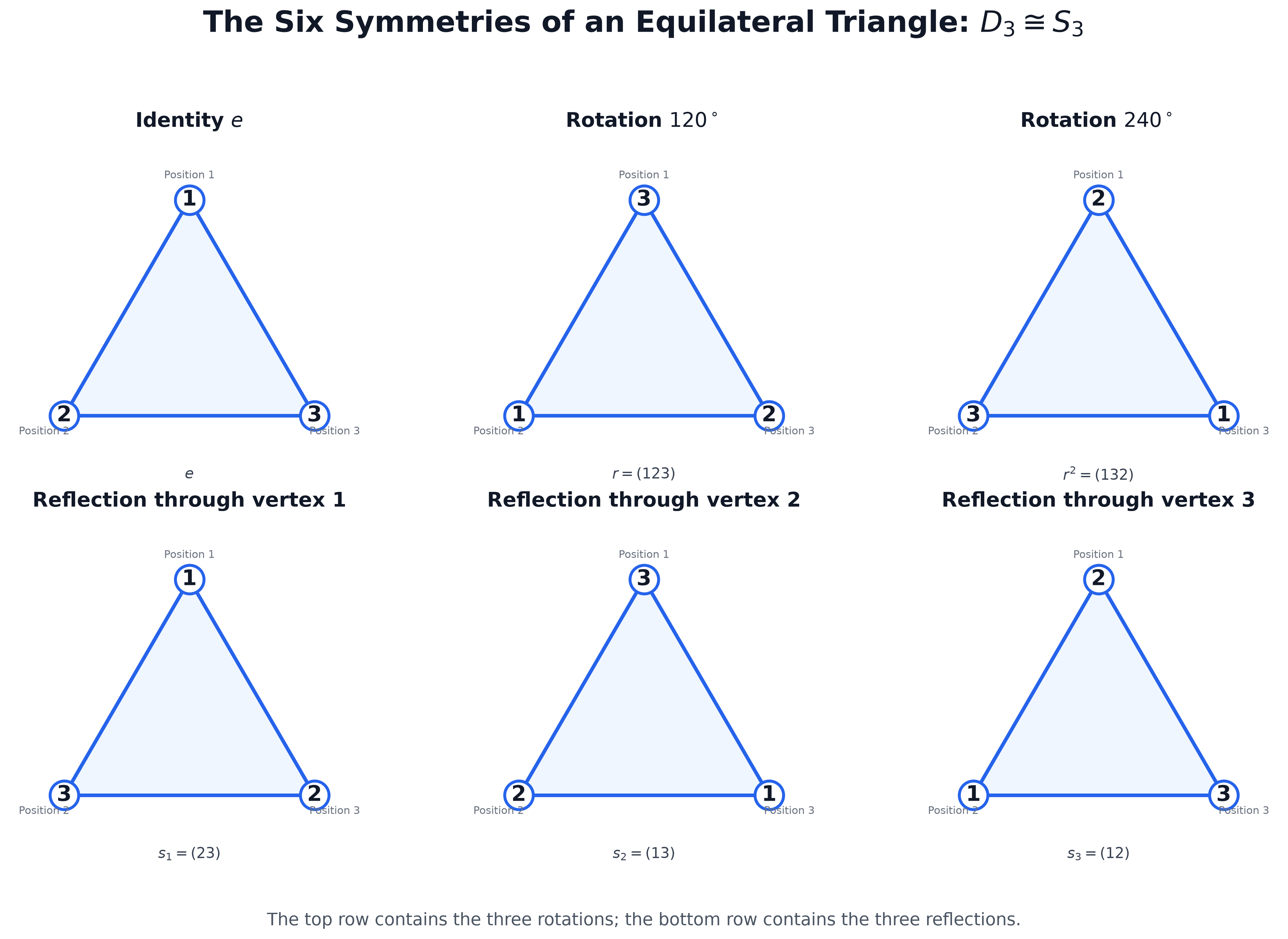
The Three Rotational Symmetries
1. Rotation through \(0^\circ\)
The triangle remains unchanged:
\[ 1\mapsto1,\qquad2\mapsto2,\qquad3\mapsto3. \]
This is the identity permutation:
\[ e= \begin{pmatrix} 1&2&3\\ 1&2&3 \end{pmatrix}. \]
In cycle notation, it is simply written as
\[ e. \]
2. Counterclockwise rotation through \(120^\circ\)
Under this rotation, the vertices move according to
\[ 1\mapsto2,\qquad2\mapsto3,\qquad3\mapsto1. \]
Therefore,
\[ r= \begin{pmatrix} 1&2&3\\ 2&3&1 \end{pmatrix} =(123). \]
The movement of the vertices may be represented by
\[ 1\longrightarrow2\longrightarrow3\longrightarrow1. \]
3. Counterclockwise rotation through \(240^\circ\)
This is the same as applying the \(120^\circ\) rotation twice. Therefore, it is denoted by \(r^2\).
The vertices move according to
\[ 1\mapsto3,\qquad3\mapsto2,\qquad2\mapsto1. \]
Thus,
\[ r^2= \begin{pmatrix} 1&2&3\\ 3&1&2 \end{pmatrix} =(132). \]
The movement of the vertices is
\[ 1\longrightarrow3\longrightarrow2\longrightarrow1. \]
After three rotations through \(120^\circ\), the triangle returns to its original position. Hence,
\[ r^3=e. \]
Diagram of the Rotational Symmetries
The three rotational symmetries can be summarized as follows:
\[ \begin{array}{ccl} 0^\circ&:&e,\\[1mm] 120^\circ&:&r=(123),\\[1mm] 240^\circ&:&r^2=(132). \end{array} \]
The rotations form the subgroup
\[ \{e,r,r^2\}. \]
This subgroup is cyclic:
\[ \langle r\rangle=\{e,r,r^2\}. \]
It is isomorphic to \(\mathbb Z_3\).
The Three Reflectional Symmetries
An equilateral triangle has three axes of reflection. Each axis passes through one vertex and the midpoint of the opposite side.
During a reflection:
- the vertex lying on the axis remains fixed;
- the other two vertices are interchanged.
Reflection Through Vertex \(1\)
Consider the axis passing through vertex \(1\) and the midpoint of the side joining vertices \(2\) and \(3\):
\[ \begin{array}{c} 1\\ \vert\\[-1mm] \triangle\\[-1mm] 2\qquad\quad3 \end{array} \]
Vertex \(1\) remains fixed, while vertices \(2\) and \(3\) are interchanged:
\[ 1\mapsto1,\qquad2\mapsto3,\qquad3\mapsto2. \]
Therefore,
\[ s_1= \begin{pmatrix} 1&2&3\\ 1&3&2 \end{pmatrix} =(23). \]
Reflection Through Vertex \(2\)
For the reflection whose axis passes through vertex \(2\), vertex \(2\) remains fixed, while vertices \(1\) and \(3\) are interchanged:
\[ 1\mapsto3,\qquad2\mapsto2,\qquad3\mapsto1. \]
Therefore,
\[ s_2= \begin{pmatrix} 1&2&3\\ 3&2&1 \end{pmatrix} =(13). \]
Reflection Through Vertex \(3\)
For the reflection whose axis passes through vertex \(3\), vertex \(3\) remains fixed, while vertices \(1\) and \(2\) are interchanged:
\[ 1\mapsto2,\qquad2\mapsto1,\qquad3\mapsto3. \]
Therefore,
\[ s_3= \begin{pmatrix} 1&2&3\\ 2&1&3 \end{pmatrix} =(12). \]
Diagram of the Reflectional Symmetries
The three reflections can be summarized as follows:
\[ \begin{array}{ccl} \text{Axis through vertex }1&:&s_1=(23),\\[1mm] \text{Axis through vertex }2&:&s_2=(13),\\[1mm] \text{Axis through vertex }3&:&s_3=(12). \end{array} \]
Each reflection has order \(2\), because applying the same reflection twice returns the triangle to its original position:
\[ s_1^2=s_2^2=s_3^2=e. \]
Correspondence Between \(D_3\) and \(S_3\)
We now have the following correspondence:
- The identity symmetry corresponds to \(e\).
- The rotation through \(120^\circ\) corresponds to \((123)\).
- The rotation through \(240^\circ\) corresponds to \((132)\).
- The reflection through vertex \(1\) corresponds to \((23)\).
- The reflection through vertex \(2\) corresponds to \((13)\).
- The reflection through vertex \(3\) corresponds to \((12)\).
Symbolically,
\[ \begin{array}{ccl} e&\longleftrightarrow&e,\\ r&\longleftrightarrow&(123),\\ r^2&\longleftrightarrow&(132),\\ s_1&\longleftrightarrow&(23),\\ s_2&\longleftrightarrow&(13),\\ s_3&\longleftrightarrow&(12). \end{array} \]
Thus, every symmetry of the triangle corresponds to exactly one permutation of its vertices, and every permutation of the vertices corresponds to exactly one symmetry.
Therefore,
\[ \boxed{D_3\cong S_3}. \]
Why This Correspondence Is an Isomorphism
Let
\[ \varphi:D_3\longrightarrow S_3 \]
be the function that assigns to every symmetry of the triangle the permutation it produces on the vertices.
This function has the following properties:
- It is well-defined: Every symmetry determines a unique permutation of the vertices.
- It is one-to-one: Different symmetries produce different permutations of the vertices.
- It is onto: Every permutation in \(S_3\) is produced by some symmetry of the triangle.
- It preserves the operation: Performing one symmetry after another corresponds to composing their associated permutations.
Thus, for any \(a,b\in D_3\),
\[ \varphi(ab)=\varphi(a)\varphi(b). \]
Therefore, \(\varphi\) is an isomorphism, and hence
\[ D_3\cong S_3. \]
Generators and Relations
We do not need all six symmetries to generate \(D_3\). One rotation and one reflection are sufficient.
Let
\[ r=(123) \]
represent rotation through \(120^\circ\), and let
\[ s=(23) \]
represent reflection through the axis passing through vertex \(1\).
Then
\[ D_3=\langle r,s\rangle. \]
These generators satisfy
\[ r^3=e,\qquad s^2=e,\qquad srs=r^{-1}. \]
Hence, a presentation of \(D_3\) is
\[ D_3= \left\langle r,s\mid r^3=e,\ s^2=e,\ srs=r^{-1} \right\rangle. \]
Since \(r^{-1}=r^2\), the last relation may also be written as
\[ srs=r^2. \]
Understanding the Relation \(srs=r^{-1}\)
Geometrically, the relation
\[ srs=r^{-1} \]
means that reflecting the triangle, rotating it through \(120^\circ\), and reflecting it again reverses the direction of the rotation.
Algebraically, with
\[ r=(123),\qquad s=(23), \]
we obtain
\[ srs=(23)(123)(23)=(132)=r^{-1}. \]
This relation captures the interaction between rotations and reflections in a dihedral group.
Why \(D_3\) Is Nonabelian
The order in which we perform a rotation and a reflection matters.
Take
\[ r=(123),\qquad s=(23). \]
Using right-to-left composition,
\[ rs=(123)(23)=(12), \]
whereas
\[ sr=(23)(123)=(13). \]
Therefore,
\[ rs\neq sr. \]
Hence, \(D_3\) is nonabelian. Since \(D_3\cong S_3\), the group \(S_3\) is also nonabelian.
Orders of the Elements
The orders of the elements of \(S_3\) and \(D_3\) can be understood geometrically:
- The identity \(e\) has order \(1\).
- The rotations \(r=(123)\) and \(r^2=(132)\) have order \(3\).
- Each reflection has order \(2\).
- Each transposition \((12),(13),(23)\) has order \(2\).
Thus, the element orders in both groups are the same.
Even and Odd Permutations in \(S_3\)
A permutation is called even if it can be expressed as a product of an even number of transpositions. It is called odd if it can be expressed as a product of an odd number of transpositions.
In \(S_3\), the even permutations are
\[ e,\qquad(123),\qquad(132). \]
Indeed,
\[ (123)=(13)(12) \]
and
\[ (132)=(12)(13). \]
Each is a product of two transpositions.
The odd permutations are
\[ (12),\qquad(13),\qquad(23). \]
Each of these is a single transposition.
From the geometric point of view:
- The three rotations correspond to the even permutations.
- The three reflections correspond to the odd permutations.
This is an important connection between the geometry of a triangle and the parity of permutations.
The Alternating Group \(A_3\)
The set of all even permutations in \(S_3\) forms the alternating group \(A_3\):
\[ A_3=\{e,(123),(132)\}. \]
Under the isomorphism \(D_3\cong S_3\), the group \(A_3\) corresponds to the rotational symmetries of the triangle:
\[ A_3\longleftrightarrow\{e,r,r^2\}. \]
Therefore,
\[ A_3\cong\mathbb Z_3. \]
Moreover, \(A_3\) is a normal subgroup of \(S_3\):
\[ A_3\trianglelefteq S_3. \]
A Quick Way to Remember the Correspondence
- Do nothing: identity permutation \(e\).
- Rotate: a \(3\)-cycle, either \((123)\) or \((132)\).
- Reflect: a transposition, one of \((12),(13),(23)\).
Thus,
\[ \boxed{\text{Rotations}\longleftrightarrow\text{even permutations}} \]
and
\[ \boxed{\text{Reflections}\longleftrightarrow\text{odd permutations}}. \]
Important Conclusions
- An equilateral triangle has exactly six symmetries.
- These six symmetries consist of three rotations and three reflections.
- The group \(S_3\) has exactly six permutations.
- Each symmetry of the triangle produces a unique permutation of its vertices.
- The rotations correspond to \(e,(123),(132)\).
- The reflections correspond to \((12),(13),(23)\).
- The rotational symmetries form a subgroup isomorphic to \(A_3\).
- Both \(S_3\) and \(D_3\) are nonabelian.
- The groups \(S_3\) and \(D_3\) have the same multiplication structure.
- Therefore, \(D_3\cong S_3\).
Final Observation
The isomorphism between \(S_3\) and \(D_3\) shows how algebra and geometry describe the same structure in different languages.
In \(S_3\), we speak about permutations of three symbols. In \(D_3\), we speak about rotations and reflections of an equilateral triangle. Once the vertices are labeled, every geometric symmetry becomes a permutation.
Therefore, the symmetry group of an equilateral triangle is precisely the symmetric group on three objects:
\[ \boxed{D_3\cong S_3}. \]